16 KiB
RISC-V Emulation (ESP32-C3 / XIAO-C3 / C3 SuperMini)
Status: Functional · In-browser emulation · No backend dependencies Engine: RiscVCore (RV32IMC) — implemented in TypeScript Platform: ESP32-C3 @ 160 MHz — 32-bit RISC-V architecture
Table of Contents
- Overview
- Supported Boards
- Emulator Architecture
- Emulated Memory and Peripherals
- Full Flow: Compile and Run
- ESP32 Image Format
- Supported ISA — RV32IMC
- GPIO
- UART0 — Serial Monitor
- Limitations
- Tests
- Differences vs Xtensa Emulation (ESP32 / ESP32-S3)
- Key Files
1. Overview
Boards based on ESP32-C3 use Espressif's ESP32-C3 processor, which implements the RISC-V RV32IMC architecture (32-bit, Multiply, Compressed instructions). Unlike the ESP32 and ESP32-S3 (Xtensa LX6/LX7), the C3 does not require QEMU or a backend to be emulated.
Emulation Engine Comparison
| Board | CPU | Engine |
|---|---|---|
| ESP32, ESP32-S3 | Xtensa LX6/LX7 | QEMU lcgamboa (backend WebSocket) |
| ESP32-C3, XIAO-C3, C3 SuperMini | RV32IMC @ 160 MHz | RiscVCore.ts (browser, no backend) |
| Arduino Uno/Nano/Mega | AVR ATmega | avr8js (browser) |
| Raspberry Pi Pico | RP2040 | rp2040js (browser) |
Advantages of the JS Emulator
- No network dependencies — works offline, no WebSocket connection to the backend
- Instant startup — no QEMU process to launch (0 ms latency)
- Testable with Vitest — the same TypeScript code that runs in production can be tested in CI
- Cross-platform — works the same on Windows, macOS, Linux, and Docker
2. Supported Boards
 ESP32-C3 DevKit |
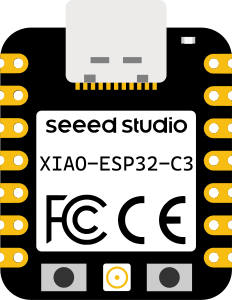 Seeed XIAO ESP32-C3 |
 ESP32-C3 SuperMini |
| Board | arduino-cli FQBN | Built-in LED |
|---|---|---|
| ESP32-C3 DevKit | esp32:esp32:esp32c3 |
GPIO 8 |
| Seeed XIAO ESP32-C3 | esp32:esp32:XIAO_ESP32C3 |
GPIO 10 (active-low) |
| ESP32-C3 SuperMini | esp32:esp32:esp32c3 |
GPIO 8 |
3. Emulator Architecture
Arduino Sketch (.ino)
        │
        ▼ arduino-cli (backend)
  sketch.ino.bin  ←  ESP32 image format (IROM/DRAM/IRAM segments)
        │
        ▼ base64 → frontend
  compileBoardProgram(boardId, base64)
        │
        ▼ Esp32C3Simulator.loadFlashImage(base64)
  parseMergedFlashImage()  ←  reads segments from the 4MB image
        │
        ├── IROM segment → flash buffer  (0x42000000)
        ├── DROM segment → flash buffer  (0x3C000000, alias)
        ├── DRAM segment → dram buffer   (0x3FC80000)
        └── IRAM segment → iram buffer   (0x4037C000)
        │
        ▼ core.reset(entryPoint)
  RiscVCore.step()  ←  requestAnimationFrame @ 60 FPS
        │             2,666,667 cycles/frame (160 MHz ÷ 60)
        ├── MMIO GPIO_W1TS/W1TC → onPinChangeWithTime → visual components
        └── MMIO UART0 FIFO    → onSerialData → Serial Monitor
Main Classes
| Class | File | Responsibility |
|---|---|---|
RiscVCore |
simulation/RiscVCore.ts |
RV32IMC decoder/executor, generic MMIO |
Esp32C3Simulator |
simulation/Esp32C3Simulator.ts |
ESP32-C3 memory map, GPIO, UART0, RAF loop |
parseMergedFlashImage |
utils/esp32ImageParser.ts |
ESP32 image format parsing (segments, entry point) |
4. Emulated Memory and Peripherals
Memory Map
| Region | Base Address | Size | Description |
|---|---|---|---|
| Flash IROM | 0x42000000 |
4 MB | Executable code (core's main buffer) |
| Flash DROM | 0x3C000000 |
4 MB | Read-only data (alias of the same buffer) |
| DRAM | 0x3FC80000 |
384 KB | Data RAM (stack, global variables) |
| IRAM | 0x4037C000 |
384 KB | Instruction RAM (ISR, time-critical code) |
| UART0 | 0x60000000 |
1 KB | Serial port 0 |
| GPIO | 0x60004000 |
512 B | GPIO registers |
GPIO — Implemented Registers
| Register | Offset | Function |
|---|---|---|
GPIO_OUT_REG |
+0x04 |
Read/write output state of all pins |
GPIO_OUT_W1TS_REG |
+0x08 |
Set bits — drive pins HIGH (write-only) |
GPIO_OUT_W1TC_REG |
+0x0C |
Clear bits — drive pins LOW (write-only) |
GPIO_IN_REG |
+0x3C |
Read input state of pins |
GPIO_ENABLE_REG |
+0x20 |
Pin direction (always returns 0xFF) |
Covers GPIO 0–21 (all available on ESP32-C3).
UART0 — Implemented Registers
| Register | Offset | Function |
|---|---|---|
UART_FIFO_REG |
+0x00 |
Write TX byte / read RX byte |
UART_STATUS_REG |
+0x1C |
FIFO status (always returns 0 = ready) |
RX byte reading is available to simulate input from the Serial Monitor.
Peripherals NOT Emulated (return 0 on read)
- Interrupt Matrix (
0x600C2000) - System / Clock (
0x600C0000,0x60008000) - Cache controller (
0x600C4000) - Timer Group 0/1
- SPI flash controller
- BLE / WiFi MAC
- ADC / DAC
These peripherals return
0by default. Code that depends on them may not function correctly (see Limitations).
5. Full Flow: Compile and Run
5.1 Compile the Sketch
# arduino-cli compiles for ESP32-C3:
arduino-cli compile \
  --fqbn esp32:esp32:esp32c3 \
  --output-dir build/ \
  mi_sketch/

# The backend automatically creates the merged image:
#   build/mi_sketch.ino.bootloader.bin  → 0x01000
#   build/mi_sketch.ino.partitions.bin  → 0x08000
#   build/mi_sketch.ino.bin             → 0x10000 (app)
#   → merged: sketch.ino.merged.bin (4 MB)
The Velxio backend produces this image automatically and sends it to the frontend as base64.
5.2 Minimal Sketch for ESP32-C3
// LED on GPIO 8 (ESP32-C3 DevKit)
#define LED_PIN 8

void setup() {
  pinMode(LED_PIN, OUTPUT);
  Serial.begin(115200);
  Serial.println("ESP32-C3 started");
}

void loop() {
  digitalWrite(LED_PIN, HIGH);
  Serial.println("LED ON");
  delay(500);
  digitalWrite(LED_PIN, LOW);
  Serial.println("LED OFF");
  delay(500);
}
5.3 Bare-Metal Sketch (for direct emulation tests)
To verify the emulation without the Arduino framework, you can compile directly with the RISC-V toolchain:
/* blink.c — bare-metal, no ESP-IDF */
#define GPIO_W1TS  (*(volatile unsigned int *)0x60004008u)
#define GPIO_W1TC  (*(volatile unsigned int *)0x6000400Cu)
#define LED_BIT    (1u << 8)

static void delay(int n) { for (volatile int i = 0; i < n; i++); }

void _start(void) {
  while (1) {
    GPIO_W1TS = LED_BIT;   /* LED ON  */
    delay(500);
    GPIO_W1TC = LED_BIT;   /* LED OFF */
    delay(500);
  }
}
Compile with the toolchain bundled in arduino-cli:
# Toolchain installed with: arduino-cli core install esp32:esp32
TOOLCHAIN="$LOCALAPPDATA/Arduino15/packages/esp32/tools/riscv32-esp-elf-gcc/esp-2021r2-patch5-8.4.0/bin"

"$TOOLCHAIN/riscv32-esp-elf-gcc" \
  -march=rv32imc -mabi=ilp32 -Os -nostdlib -nostartfiles \
  -T link.ld -o blink.elf blink.c

"$TOOLCHAIN/riscv32-esp-elf-objcopy" -O binary blink.elf blink.bin
See full script: frontend/src/__tests__/fixtures/esp32c3-blink/build.sh
6. ESP32 Image Format
The backend produces a merged 4 MB image:
Offset 0x00000: 0xFF (empty)
Offset 0x01000: bootloader   (ESP32 format image, magic 0xE9)
Offset 0x08000: partition table
Offset 0x10000: app binary   (ESP32 format image, magic 0xE9) ← parsed here
ESP32 Image Header (24 bytes)
+0x00  magic (0xE9)
+0x01  segment_count
+0x02  spi_mode
+0x03  spi_speed_size
+0x04  entry_addr       ← uint32 LE — firmware entry point PC
+0x08  extended fields (16 bytes)
Segment Header (8 bytes)
+0x00  load_addr   ← destination virtual address (e.g. 0x42000000)
+0x04  data_len
+0x08  data[data_len]
The parseMergedFlashImage() parser in utils/esp32ImageParser.ts extracts all segments and the entry point, which is used for the core reset (core.reset(entryPoint)).
7. Supported ISA — RV32IMC
RiscVCore.ts implements the three extensions required to run code compiled for ESP32-C3:
RV32I — Base Integer (40 instructions)
Includes: LUI, AUIPC, JAL, JALR, BEQ/BNE/BLT/BGE/BLTU/BGEU, LB/LH/LW/LBU/LHU, SB/SH/SW, ADDI/SLTI/SLTIU/XORI/ORI/ANDI/SLLI/SRLI/SRAI, ADD/SUB/SLL/SLT/SLTU/XOR/SRL/SRA/OR/AND, FENCE, ECALL/EBREAK, CSR (reads return 0)
RV32M — Multiply and Divide (8 instructions)
| Instruction | Operation |
|---|---|
MUL |
Integer product (low 32 bits) |
MULH |
Signed product (high 32 bits) |
MULHSU |
Mixed signed×unsigned product (high bits) |
MULHU |
Unsigned product (high 32 bits) |
DIV |
Signed integer division |
DIVU |
Unsigned integer division |
REM |
Signed remainder |
REMU |
Unsigned remainder |
RV32C — Compressed Instructions (16-bit)
All 16-bit instructions from the standard C extension are supported. They are detected by (halfword & 3) !== 3 and decompressed to their RV32I equivalent before execution. This is critical: the GCC compiler for ESP32-C3 heavily generates C instructions (c.addi, c.sw, c.lw, c.j, c.beqz, c.bnez, etc.) which represent ~30-40% of all instructions in the final binary.
8. GPIO
GPIO handling follows the W1TS/W1TC register model of the ESP32-C3:
// Arduino sketch:
digitalWrite(8, HIGH);  // → internally writes 1<<8 to GPIO_OUT_W1TS_REG

// In the simulator:
// SW x10, 0(x12)  where x10=256 (1<<8), x12=0x60004008 (W1TS)
// → writes 4 bytes to 0x60004008..0x6000400B
// → byteIdx=1 (offset 0x09): val=0x01, shift=8 → gpioOut |= 0x100
// → changed = prev ^ gpioOut ≠ 0 → fires onPinChangeWithTime(8, true, timeMs)
The callback onPinChangeWithTime(pin, state, timeMs) is the integration point with the visual components. timeMs is the simulated time in milliseconds (calculated as core.cycles / CPU_HZ * 1000).
9. UART0 — Serial Monitor
Any byte written to UART0_FIFO_REG (0x60000000) calls the onSerialData(char) callback:
// Arduino sketch:
Serial.println("Hello!");
// → Arduino framework writes the bytes of "Hello!\r\n" to UART0_FIFO_REG
// → simulator calls onSerialData("H"), onSerialData("e"), ...
// → Serial Monitor displays "Hello!"
To send data to the sketch from the Serial Monitor:
sim.serialWrite("COMMAND\n");
// → bytes are added to rxFifo
// → reading UART0_FIFO_REG dequeues one byte from rxFifo
10. Limitations
ESP-IDF / Arduino Framework
The Arduino framework for ESP32-C3 (based on ESP-IDF 4.4.x) has a complex initialization sequence that accesses non-emulated peripherals:
| Peripheral | Why ESP-IDF accesses it | Effect in emulator |
|---|---|---|
| Cache controller | Configures MMU for flash/DRAM mapping | Reads 0, may not loop |
| Interrupt Matrix | Registers ISR vectors | No effect (silenced) |
| System registers | Configures PLLs and clocks | Reads 0 (assumes default speed) |
| FreeRTOS tick timer | Timer 0 → periodic interrupt | No interrupt = tasks not scheduled |
As a result, an Arduino sketch compiled with the full framework may execute partially — code prior to FreeRTOS initialization may work, but setup() and loop() depend on FreeRTOS running.
Scenarios that DO work:
- Bare-metal code (no framework, direct GPIO MMIO access)
- Code fragments that do not use FreeRTOS (
delay(),millis(),digitalWrite()require FreeRTOS) - ISA test programs (arithmetic operations, branches, loads/stores to DRAM)
Roadmap for full support:
- Cache controller stub (return values indicating "cache already configured")
- Interrupt matrix stub (accept writes, ignore)
- Basic timer peripheral (generate FreeRTOS tick periodically)
- Once FreeRTOS is active: normal Arduino sketches should work
Other Limitations
| Limitation | Detail |
|---|---|
| No WiFi | ESP32-C3 has BLE/WiFi radio; not emulated |
| No ADC | GPIO 0-5 as ADC not implemented |
| No hardware SPI/I2C | Hardware SPI/I2C peripherals return 0 |
| No interrupts | attachInterrupt() does not work |
| No RTC | esp_sleep_*, rtc_* not implemented |
| No NVS/Flash writes | Preferences, SPIFFS not implemented |
11. Tests
RISC-V emulation tests are in frontend/src/__tests__/:
cd frontend
npm test -- esp32c3
esp32c3-simulation.test.ts — 30 tests (ISA unit tests)
Directly verifies the instruction decoder in RiscVCore:
| Group | Tests | What it verifies |
|---|---|---|
| RV32M | 8 | MUL, MULH, MULHSU, MULHU, DIV, DIVU, REM, REMU |
| RV32C | 7 | C.ADDI, C.LI, C.LWSP, C.SWSP, C.MV, C.ADD, C.J, C.BEQZ |
| UART | 3 | Write to FIFO → onSerialData, RX read, multiple bytes |
| GPIO | 8 | W1TS set bit, W1TC clear bit, toggle, timestamp, multiple pins |
| Lifecycle | 4 | reset(), start/stop, basic loadHex |
esp32c3-blink.test.ts — 8 tests (end-to-end integration)
Compiles blink.c with riscv32-esp-elf-gcc (the arduino-cli toolchain) and verifies execution in the simulator:
| Test | What it verifies |
|---|---|
build.sh produces blink.bin |
Toolchain compiles correctly |
binary starts with valid RV32 instruction |
Entry point is valid RISC-V code |
loadBin() resets PC to 0x42000000 |
Correct loading into flash |
GPIO 8 goes HIGH after first SW |
First toggle correct |
GPIO 8 toggles ON and OFF |
7 toggles in 2000 steps (4 ON, 3 OFF) |
PinManager.setPinState called |
Integration with the component system |
timestamps increase monotonically |
Simulated time is consistent |
reset() clears GPIO state |
Functional reset |
Expected result:
✓ esp32c3-simulation.test.ts  (30 tests)  ~500ms
✓ esp32c3-blink.test.ts        (8 tests)  ~300ms
Bare-Metal Test Binary
frontend/src/__tests__/fixtures/esp32c3-blink/
├── blink.c       ← bare-metal source code
├── link.ld       ← linker script (IROM @ 0x42000000, DRAM @ 0x3FC80000)
├── build.sh      ← build script (uses arduino-cli toolchain)
├── blink.elf     ← (generated) ELF with debug info
├── blink.bin     ← (generated) raw 58-byte binary
└── blink.dis     ← (generated) disassembly for inspection
12. Differences vs Xtensa Emulation (ESP32 / ESP32-S3)
| Aspect | ESP32-C3 (RISC-V) | ESP32 / ESP32-S3 (Xtensa) |
|---|---|---|
| Engine | Esp32C3Simulator (TypeScript, browser) |
Esp32Bridge + backend QEMU |
| Backend dependency | No — 100% in the browser | Yes — WebSocket to QEMU process |
| Startup | Instant | ~1-2 seconds |
| GPIO | Via MMIO W1TS/W1TC | Via QEMU callbacks → WebSocket |
| WiFi | Not emulated | Emulated (hardcoded SSIDs) |
| Hardware I2C/SPI | Not emulated | Emulated (synchronous callbacks) |
| LEDC/PWM | Not emulated | Emulated (periodic polling) |
| NeoPixel/RMT | Not emulated | Emulated (RMT decoder) |
| Arduino framework | Partial (FreeRTOS not active) | Full |
| CI tests | Yes (Vitest) | No (requires native lib) |
13. Key Files
| File | Description |
|---|---|
frontend/src/simulation/RiscVCore.ts |
RV32IMC emulator core (I + M + C extensions) |
frontend/src/simulation/Esp32C3Simulator.ts |
ESP32-C3 memory map, GPIO, UART0, RAF loop |
frontend/src/utils/esp32ImageParser.ts |
ESP32 image format parser (merged flash → segments) |
frontend/src/store/useSimulatorStore.ts |
ESP32_RISCV_KINDS, createSimulator(), compileBoardProgram() |
frontend/src/__tests__/esp32c3-simulation.test.ts |
ISA unit tests (30 tests) |
frontend/src/__tests__/esp32c3-blink.test.ts |
End-to-end integration test (8 tests) |
frontend/src/__tests__/fixtures/esp32c3-blink/ |
Bare-metal test firmware + toolchain script |