23 KiB
RISC-V Emulation (ESP32-C3 / XIAO-C3 / C3 SuperMini)
Status: Functional · Backend QEMU (
libqemu-riscv32) — same pattern as ESP32/ESP32-S3 Engine: QEMU lcgamboa — riscv32-softmmu compiled withesp32c3-picsimlabmachine Platform: ESP32-C3 @ 160 MHz — 32-bit RISC-V RV32IMC architecture
Unit-test / ISA layer:
RiscVCore.tsandEsp32C3Simulator.tsare TypeScript implementations used exclusively for Vitest unit tests; they are not the production emulation path.
Table of Contents
- Overview
- Supported Boards
- Architecture — QEMU Backend Path
- Setup on Windows — Building
libqemu-riscv32.dll - Setup on Linux / Docker
- GPIO Pinmap — 22 GPIOs
- Full Flow: Compile and Run
- ESP32 Image Format
- Supported ISA — RV32IMC
- GPIO — MMIO Registers
- UART0 — Serial Monitor
- Limitations of the riscv32 QEMU machine
- Tests
- Differences vs Xtensa Emulation (ESP32 / ESP32-S3)
- Key Files
1. Overview
Boards based on ESP32-C3 use Espressif's ESP32-C3 processor, implementing the RISC-V RV32IMC architecture. In production the system uses the same QEMU backend pattern as ESP32/ESP32-S3, but with a different library (libqemu-riscv32) and a different machine target (esp32c3-picsimlab).
The browser-side TypeScript emulator (
RiscVCore.ts+Esp32C3Simulator.ts) cannot handle the 150+ ROM functions that ESP-IDF needs during initialization. All production runs go through the QEMU backend. The TypeScript layer is kept as unit-test infrastructure for the RV32IMC ISA.
Emulation Engine Comparison
| Board | CPU | Production Engine | Unit-Test Engine |
|---|---|---|---|
| ESP32, ESP32-S3 | Xtensa LX6/LX7 | QEMU lcgamboa libqemu-xtensa |
— |
| ESP32-C3, XIAO-C3, C3 SuperMini | RV32IMC @ 160 MHz | QEMU lcgamboa libqemu-riscv32 |
RiscVCore.ts (Vitest) |
| Arduino Uno/Nano/Mega | AVR ATmega | avr8js (browser) | — |
| Raspberry Pi Pico | RP2040 | rp2040js (browser) | — |
Key differences vs Xtensa (ESP32)
- Different library:
libqemu-riscv32.dll/.soinstead oflibqemu-xtensa - Different machine:
esp32c3-picsimlabinstead ofesp32-picsimlab - 22 GPIOs (GPIO 0–21) instead of 40; worker auto-adjusts pinmap
- ROM file:
esp32c3-rom.bin(384 KB) instead ofesp32-v3-rom.bin - WiFi, LEDC/PWM, RMT/NeoPixel: not yet emulated in the riscv32 machine
- Build flag:
--disable-slirprequired (riscv32 target has incompatible pointer types innet/slirp.c)
2. Supported Boards
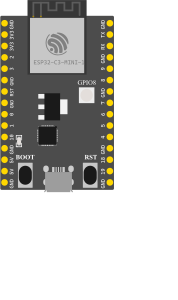 ESP32-C3 DevKit |
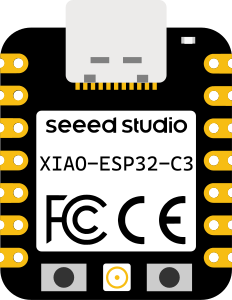 Seeed XIAO ESP32-C3 |
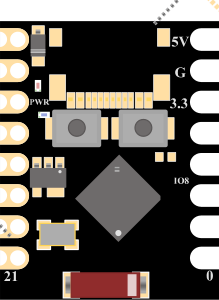 ESP32-C3 SuperMini |
| Board | arduino-cli FQBN | Built-in LED |
|---|---|---|
| ESP32-C3 DevKit | esp32:esp32:esp32c3 |
GPIO 8 |
| Seeed XIAO ESP32-C3 | esp32:esp32:XIAO_ESP32C3 |
GPIO 10 (active-low) |
| ESP32-C3 SuperMini | esp32:esp32:esp32c3 |
GPIO 8 |
3. Architecture — QEMU Backend Path
User (browser)
  └── WebSocket (/ws/{client_id})
        └── simulation.py  (FastAPI router)
              └── EspLibManager
                    │
              board_type in _RISCV_BOARDS?
              ├── YES → lib_path = LIB_RISCV_PATH  (libqemu-riscv32.dll/.so)
              │           machine  = 'esp32c3-picsimlab'
              │           _build_pinmap(22)          ← 22 GPIOs, not 40
              └── NO  → lib_path = LIB_PATH          (libqemu-xtensa.dll/.so)
                          machine  = 'esp32-picsimlab' or 'esp32s3-picsimlab'
                          pinmap = 40 GPIOs
                    │
              esp32_worker.py (subprocess)
                    │
              ctypes.CDLL(libqemu-riscv32.dll)
                    │
              Machine: esp32c3-picsimlab
              CPU:     RISC-V RV32IMC @ 160 MHz
                    │
         ┌──────────┴──────────┐
     ESP32-C3 core         emulated peripherals
     (single core)    GPIO (22 pins) · UART0 · SPI Flash
Required files (same directory as the lib):
| File | Size | Source |
|---|---|---|
libqemu-riscv32.dll |
~58 MB | Compiled from wokwi-libs/qemu-lcgamboa (see §4) |
esp32c3-rom.bin |
384 KB | wokwi-libs/qemu-lcgamboa/pc-bios/esp32c3-rom.bin |
TypeScript / Browser layer (unit tests only)
The RiscVCore.ts + Esp32C3Simulator.ts classes exist for Vitest unit tests only. They provide a fast, offline RV32IMC interpreter that can run bare-metal binaries. They cannot handle the full ESP-IDF initialization sequence needed by real Arduino sketches.
| Class | File | Used in |
|---|---|---|
RiscVCore |
simulation/RiscVCore.ts |
Vitest ISA unit tests |
Esp32C3Simulator |
simulation/Esp32C3Simulator.ts |
Vitest end-to-end tests |
parseMergedFlashImage |
utils/esp32ImageParser.ts |
Vitest + compile flow |
4. Setup on Windows — Building libqemu-riscv32.dll
This section covers building the RISC-V QEMU library from source on Windows with MSYS2.
4.1 Prerequisites
Same as the Xtensa build (see ESP32_EMULATION.md §1.1–1.4), except:
--disable-slirpis required —net/slirp.chas incompatible pointer types in the riscv32-softmmu target that cause a compile error with GCC 15.x.--enable-gcryptis required — matches the working Xtensa DLL linking pattern and avoids GCC emutls/pthread crash on Windows.
Install MSYS2 dependencies (same as Xtensa, without libslirp):
pacman -S \
  mingw-w64-x86_64-gcc \
  mingw-w64-x86_64-glib2 \
  mingw-w64-x86_64-libgcrypt \
  mingw-w64-x86_64-pixman \
  mingw-w64-x86_64-ninja \
  mingw-w64-x86_64-meson \
  mingw-w64-x86_64-python \
  mingw-w64-x86_64-pkg-config \
  git diffutils
4.2 Configure and Build
# In MSYS2 MINGW64:
cd /e/Hardware/wokwi_clon/wokwi-libs/qemu-lcgamboa

mkdir build-riscv && cd build-riscv

../configure \
  --target-list=riscv32-softmmu \
  --disable-werror \
  --disable-alsa \
  --enable-tcg \
  --enable-system \
  --enable-gcrypt \
  --disable-slirp \
  --enable-iconv \
  --without-default-features \
  --disable-docs

ninja          # compiles ~1430 objects, takes 15-30 min first time
Why
--disable-slirp? GCC 15.x rejects thenet/slirp.ccode in the riscv32 machine due to incompatible pointer types inslirp_smb_init. Adding-fpermissiveor-Wno-incompatible-pointer-typesis also an option, but--disable-slirpis cleaner since this machine does not need network emulation.
4.3 Create the DLL (keeprsp trick)
QEMU's build system produces an executable (qemu-system-riscv32.exe) rather than a shared library. To get a DLL, relink all objects and exclude softmmu_main.c.obj (which contains main()):
# From build-riscv/:

# 1. Build the full exe first to generate the link response file:
ninja qemu-system-riscv32.exe

# 2. Capture the link command from ninja's database:
ninja -t commands qemu-system-riscv32.exe | tail -1 > dll_link.rsp

# 3. Edit dll_link.rsp:
#    - Replace -o qemu-system-riscv32.exe with: -shared -o libqemu-riscv32.dll
#    - Remove the softmmu_main.c.obj entry
#    - Add: -Wl,--export-all-symbols -Wl,--allow-multiple-definition

# 4. Relink:
gcc @dll_link.rsp

# 5. Verify:
ls -lh libqemu-riscv32.dll      # should be ~58 MB
objdump -p libqemu-riscv32.dll | grep qemu_picsimlab
4.4 Copy to Backend
cp libqemu-riscv32.dll /e/Hardware/wokwi_clon/backend/app/services/
cp ../pc-bios/esp32c3-rom.bin /e/Hardware/wokwi_clon/backend/app/services/
Verify:
ls -lh /e/Hardware/wokwi_clon/backend/app/services/libqemu-riscv32.dll
ls -lh /e/Hardware/wokwi_clon/backend/app/services/esp32c3-rom.bin
# libqemu-riscv32.dll  ~58 MB
# esp32c3-rom.bin      384 KB
4.5 Verify DLL Loads
# Run from backend/ with venv active:
python -c "
import ctypes, os
os.add_dll_directory(r'C:\msys64\mingw64\bin')
lib = ctypes.CDLL(r'app/services/libqemu-riscv32.dll')
print('qemu_init:', lib.qemu_init)
print('qemu_picsimlab_register_callbacks:', lib.qemu_picsimlab_register_callbacks)
print('OK — DLL loaded successfully')
"
4.6 Verify Emulation End-to-End
cd backend
python test_esp32c3_emulation.py
# Expected: PASS — GPIO8 toggled 2 times — ESP32-C3 emulation is working!
5. Setup on Linux / Docker
5.1 Docker (automatic)
The Dockerfile should compile libqemu-riscv32.so alongside libqemu-xtensa.so. Add the riscv32 target to the configure step:
RUN cd /tmp/qemu-lcgamboa && ../configure \
      --target-list=xtensa-softmmu,riscv32-softmmu \
      --enable-gcrypt \
      --disable-slirp \
      ... \
  && ninja \
  && cp build/libqemu-xtensa.so /app/lib/ \
  && cp build/libqemu-riscv32.so /app/lib/ \
  && cp pc-bios/esp32c3-rom.bin /app/lib/
5.2 Linux (manual)
sudo apt-get install -y libglib2.0-dev libgcrypt20-dev libpixman-1-dev libfdt-dev

cd wokwi-libs/qemu-lcgamboa
mkdir build-riscv && cd build-riscv

../configure \
  --target-list=riscv32-softmmu \
  --enable-gcrypt \
  --disable-slirp \
  --without-default-features \
  --disable-docs

ninja
cp libqemu-riscv32.so ../../backend/app/services/
cp ../pc-bios/esp32c3-rom.bin ../../backend/app/services/
6. GPIO Pinmap — 22 GPIOs
The ESP32-C3 has 22 GPIOs (GPIO 0–21), fewer than the 40 on the ESP32. The QEMU machine (esp32c3-picsimlab) registers only 22 GPIO output lines in the QOM model. Sending a pinmap with more entries causes a QEMU property lookup error:
qemu: Property 'esp32c3.gpio.esp32_gpios[22]' not found
The worker (esp32_worker.py) detects the machine and rebuilds the pinmap before registering callbacks:
# In main(), right after reading config:
if 'c3' in machine:          # 'esp32c3-picsimlab'
    _build_pinmap(22)        # GPIO 0..21 only
# else: default pinmap (40 GPIOs for ESP32/ESP32-S3)
_build_pinmap(n) creates a ctypes.c_int16 array of n+1 elements:
def _build_pinmap(gpio_count: int):
    global _GPIO_COUNT, _PINMAP
    _GPIO_COUNT = gpio_count
    _PINMAP = (ctypes.c_int16 * (gpio_count + 1))(
        gpio_count,        # [0] = count
        *range(gpio_count) # [1..n] = GPIO numbers 0..n-1
    )
This is passed to QEMU via _cbs_ref.pinmap. When GPIO N changes, QEMU calls picsimlab_write_pin(slot=N+1, value) and the worker translates slot → N before emitting {type: gpio_change, pin: N, state: value}.
7. Full Flow: Compile and Run
7.1 Compile the Sketch
# arduino-cli compiles for ESP32-C3:
arduino-cli compile \
  --fqbn esp32:esp32:esp32c3 \
  --output-dir build/ \
  mi_sketch/

# The backend automatically creates the merged image:
#   build/mi_sketch.ino.bootloader.bin  → 0x01000
#   build/mi_sketch.ino.partitions.bin  → 0x08000
#   build/mi_sketch.ino.bin             → 0x10000 (app)
#   → merged: sketch.ino.merged.bin (4 MB)
The Velxio backend produces this image automatically and sends it to the frontend as base64.
7.2 Minimal Sketch for ESP32-C3
// LED on GPIO 8 (ESP32-C3 DevKit)
#define LED_PIN 8

void setup() {
  pinMode(LED_PIN, OUTPUT);
  Serial.begin(115200);
  Serial.println("ESP32-C3 started");
}

void loop() {
  digitalWrite(LED_PIN, HIGH);
  Serial.println("LED ON");
  delay(500);
  digitalWrite(LED_PIN, LOW);
  Serial.println("LED OFF");
  delay(500);
}
7.3 Bare-Metal Sketch (for unit-test runner only)
To verify the emulation without the Arduino framework, you can compile directly with the RISC-V toolchain:
/* blink.c — bare-metal, no ESP-IDF */
#define GPIO_W1TS  (*(volatile unsigned int *)0x60004008u)
#define GPIO_W1TC  (*(volatile unsigned int *)0x6000400Cu)
#define LED_BIT    (1u << 8)

static void delay(int n) { for (volatile int i = 0; i < n; i++); }

void _start(void) {
  while (1) {
    GPIO_W1TS = LED_BIT;   /* LED ON  */
    delay(500);
    GPIO_W1TC = LED_BIT;   /* LED OFF */
    delay(500);
  }
}
Compile with the toolchain bundled in arduino-cli:
# Toolchain installed with: arduino-cli core install esp32:esp32
TOOLCHAIN="$LOCALAPPDATA/Arduino15/packages/esp32/tools/riscv32-esp-elf-gcc/esp-2021r2-patch5-8.4.0/bin"

"$TOOLCHAIN/riscv32-esp-elf-gcc" \
  -march=rv32imc -mabi=ilp32 -Os -nostdlib -nostartfiles \
  -T link.ld -o blink.elf blink.c

"$TOOLCHAIN/riscv32-esp-elf-objcopy" -O binary blink.elf blink.bin
See full script: frontend/src/__tests__/fixtures/esp32c3-blink/build.sh
8. ESP32 Image Format
The backend produces a merged 4 MB image:
Offset 0x00000: 0xFF (empty)
Offset 0x01000: bootloader   (ESP32 format image, magic 0xE9)
Offset 0x08000: partition table
Offset 0x10000: app binary   (ESP32 format image, magic 0xE9) ← parsed here
ESP32 Image Header (24 bytes)
+0x00  magic (0xE9)
+0x01  segment_count
+0x02  spi_mode
+0x03  spi_speed_size
+0x04  entry_addr       ← uint32 LE — firmware entry point PC
+0x08  extended fields (16 bytes)
Segment Header (8 bytes)
+0x00  load_addr   ← destination virtual address (e.g. 0x42000000)
+0x04  data_len
+0x08  data[data_len]
The parseMergedFlashImage() parser in utils/esp32ImageParser.ts extracts all segments and the entry point, which is used for the core reset (core.reset(entryPoint)).
9. Supported ISA — RV32IMC
RiscVCore.ts implements the three extensions required to run code compiled for ESP32-C3:
RV32I — Base Integer (40 instructions)
Includes: LUI, AUIPC, JAL, JALR, BEQ/BNE/BLT/BGE/BLTU/BGEU, LB/LH/LW/LBU/LHU, SB/SH/SW, ADDI/SLTI/SLTIU/XORI/ORI/ANDI/SLLI/SRLI/SRAI, ADD/SUB/SLL/SLT/SLTU/XOR/SRL/SRA/OR/AND, FENCE, ECALL/EBREAK, CSR (reads return 0)
RV32M — Multiply and Divide (8 instructions)
| Instruction | Operation |
|---|---|
MUL |
Integer product (low 32 bits) |
MULH |
Signed product (high 32 bits) |
MULHSU |
Mixed signed×unsigned product (high bits) |
MULHU |
Unsigned product (high 32 bits) |
DIV |
Signed integer division |
DIVU |
Unsigned integer division |
REM |
Signed remainder |
REMU |
Unsigned remainder |
RV32C — Compressed Instructions (16-bit)
All 16-bit instructions from the standard C extension are supported. They are detected by (halfword & 3) !== 3 and decompressed to their RV32I equivalent before execution. This is critical: the GCC compiler for ESP32-C3 heavily generates C instructions (c.addi, c.sw, c.lw, c.j, c.beqz, c.bnez, etc.) which represent ~30-40% of all instructions in the final binary.
10. GPIO — MMIO Registers
Note: these registers are used by the TypeScript unit-test layer (
RiscVCore.ts). The QEMU backend handles GPIO via thepicsimlab_write_pincallback, not MMIO polling.
GPIO MMIO layout on the ESP32-C3:
// Arduino sketch:
digitalWrite(8, HIGH);  // → internally writes 1<<8 to GPIO_OUT_W1TS_REG

// In the simulator:
// SW x10, 0(x12)  where x10=256 (1<<8), x12=0x60004008 (W1TS)
// → writes 4 bytes to 0x60004008..0x6000400B
// → byteIdx=1 (offset 0x09): val=0x01, shift=8 → gpioOut |= 0x100
// → changed = prev ^ gpioOut ≠ 0 → fires onPinChangeWithTime(8, true, timeMs)
The callback onPinChangeWithTime(pin, state, timeMs) is the integration point with the visual components. timeMs is the simulated time in milliseconds (calculated as core.cycles / CPU_HZ * 1000).
11. UART0 — Serial Monitor
Any byte written to UART0_FIFO_REG (0x60000000) calls the onSerialData(char) callback:
// Arduino sketch:
Serial.println("Hello!");
// → Arduino framework writes the bytes of "Hello!\r\n" to UART0_FIFO_REG
// → simulator calls onSerialData("H"), onSerialData("e"), ...
// → Serial Monitor displays "Hello!"
To send data to the sketch from the Serial Monitor:
sim.serialWrite("COMMAND\n");
// → bytes are added to rxFifo
// → reading UART0_FIFO_REG dequeues one byte from rxFifo
12. Limitations of the riscv32 QEMU machine
The esp32c3-picsimlab QEMU machine in the lcgamboa fork emulates the core CPU and GPIO. The following are not yet implemented in the QEMU machine (as of 2026-03):
| Feature | Status | Notes |
|---|---|---|
| WiFi / BLE | Not emulated | No slirp networking in riscv32 machine |
| LEDC / PWM | Not emulated | No rmt/ledc callbacks yet |
| RMT / NeoPixel | Not emulated | No RMT peripheral in esp32c3-picsimlab |
| ADC | Not emulated | GPIO 0-5 ADC channels not wired |
| Hardware I2C / SPI | Not emulated | Callbacks not registered |
Interrupts (attachInterrupt) |
Not emulated | GPIO interrupt lines not connected |
| NVS / SPIFFS | Not emulated | Flash writes not persisted |
| arduino-esp32 3.x (IDF 5.x) | Unsupported | Use 2.0.17 (IDF 4.4.x) — same as Xtensa |
The QEMU machine boots the ESP-IDF bootloader and transitions to the Arduino
setup()/loop()correctly for GPIO and UART sketches. Sketches using WiFi, LEDC, or RMT will boot but those peripherals will silently do nothing.
13. Tests
13.1 End-to-End Test (Backend QEMU)
File: backend/test_esp32c3_emulation.py
cd backend
python test_esp32c3_emulation.py
# Expected: PASS — GPIO8 toggled 2 times — ESP32-C3 emulation is working!
Compiles a blink sketch via arduino-cli, merges a 4 MB flash image, launches the worker, and checks that GPIO8 toggles at least twice within 45 s.
13.2 RiscVCore ISA Unit Tests (TypeScript)
RISC-V emulation tests are in frontend/src/__tests__/:
cd frontend
npm test -- esp32c3
esp32c3-simulation.test.ts — 30 tests (ISA unit tests)
Directly verifies the instruction decoder in RiscVCore:
| Group | Tests | What it verifies |
|---|---|---|
| RV32M | 8 | MUL, MULH, MULHSU, MULHU, DIV, DIVU, REM, REMU |
| RV32C | 7 | C.ADDI, C.LI, C.LWSP, C.SWSP, C.MV, C.ADD, C.J, C.BEQZ |
| UART | 3 | Write to FIFO → onSerialData, RX read, multiple bytes |
| GPIO | 8 | W1TS set bit, W1TC clear bit, toggle, timestamp, multiple pins |
| Lifecycle | 4 | reset(), start/stop, basic loadHex |
esp32c3-blink.test.ts — 8 tests (end-to-end integration)
Compiles blink.c with riscv32-esp-elf-gcc (the arduino-cli toolchain) and verifies execution in the simulator:
| Test | What it verifies |
|---|---|
build.sh produces blink.bin |
Toolchain compiles correctly |
binary starts with valid RV32 instruction |
Entry point is valid RISC-V code |
loadBin() resets PC to 0x42000000 |
Correct loading into flash |
GPIO 8 goes HIGH after first SW |
First toggle correct |
GPIO 8 toggles ON and OFF |
7 toggles in 2000 steps (4 ON, 3 OFF) |
PinManager.setPinState called |
Integration with the component system |
timestamps increase monotonically |
Simulated time is consistent |
reset() clears GPIO state |
Functional reset |
Expected result:
Note: these TypeScript tests run against
RiscVCore.ts(the in-browser interpreter), not against the QEMU backend.
✓ esp32c3-simulation.test.ts  (30 tests)  ~500ms
✓ esp32c3-blink.test.ts        (8 tests)  ~300ms
Bare-Metal Test Binary
frontend/src/__tests__/fixtures/esp32c3-blink/
├── blink.c       ← bare-metal source code
├── link.ld       ← linker script (IROM @ 0x42000000, DRAM @ 0x3FC80000)
├── build.sh      ← build script (uses arduino-cli toolchain)
├── blink.elf     ← (generated) ELF with debug info
├── blink.bin     ← (generated) raw 58-byte binary
└── blink.dis     ← (generated) disassembly for inspection
14. Differences vs Xtensa Emulation (ESP32 / ESP32-S3)
| Aspect | ESP32-C3 (RISC-V) | ESP32 / ESP32-S3 (Xtensa) |
|---|---|---|
| QEMU library | libqemu-riscv32.dll/.so |
libqemu-xtensa.dll/.so |
| QEMU machine | esp32c3-picsimlab |
esp32-picsimlab / esp32s3-picsimlab |
| ROM file | esp32c3-rom.bin (384 KB) |
esp32-v3-rom.bin + esp32-v3-rom-app.bin |
| GPIO count | 22 (GPIO 0–21) | 40 (GPIO 0–39) |
| Build target | --target-list=riscv32-softmmu |
--target-list=xtensa-softmmu |
--disable-slirp required |
Yes (slirp.c incompatible pointer types with riscv32) | No (slirp works with xtensa) |
| WiFi | Not emulated | Emulated (hardcoded SSIDs via SLIRP) |
| LEDC/PWM | Not emulated | Emulated (periodic polling via internals) |
| NeoPixel/RMT | Not emulated | Emulated (RMT decoder in worker) |
| I2C / SPI | Not emulated | Emulated (synchronous QEMU callbacks) |
| GPIO32–39 fix | N/A (only 22 GPIOs) | Required (bank 1 register) |
| Arduino framework | Full (IDF 4.4.x) | Full (IDF 4.4.x) |
| ISA unit tests | Yes (Vitest — RiscVCore.ts) | No (requires native lib) |
15. Key Files
Backend
| File | Description |
|---|---|
backend/app/services/libqemu-riscv32.dll |
QEMU riscv32 shared library (not in git — build locally) |
backend/app/services/esp32c3-rom.bin |
ESP32-C3 boot ROM (not in git — copy from pc-bios/) |
backend/app/services/esp32_worker.py |
QEMU subprocess worker; calls _build_pinmap(22) for C3 |
backend/app/services/esp32_lib_manager.py |
_RISCV_BOARDS, _MACHINE, LIB_RISCV_PATH; selects right DLL |
backend/test_esp32c3_emulation.py |
End-to-end test: compile → flash → QEMU worker → GPIO toggle |
Frontend
| File | Description |
|---|---|
frontend/src/store/useSimulatorStore.ts |
ESP32_RISCV_KINDS set; isRiscVEsp32Kind() routes to QEMU bridge |
frontend/src/simulation/RiscVCore.ts |
RV32IMC interpreter (unit-test layer only) |
frontend/src/simulation/Esp32C3Simulator.ts |
ESP32-C3 SoC wrapper (unit-test layer only) |
frontend/src/utils/esp32ImageParser.ts |
ESP32 image format parser (merged flash → segments) |
frontend/src/__tests__/esp32c3-simulation.test.ts |
RV32IMC ISA unit tests (30 tests — TypeScript only) |
frontend/src/__tests__/esp32c3-blink.test.ts |
End-to-end bare-metal test (8 tests — TypeScript only) |
frontend/src/__tests__/fixtures/esp32c3-blink/ |
Bare-metal test firmware + toolchain script |
QEMU Source
| File | Description |
|---|---|
wokwi-libs/qemu-lcgamboa/hw/riscv/esp32c3_picsimlab.c |
ESP32-C3 PICSimLab machine definition |
wokwi-libs/qemu-lcgamboa/hw/gpio/esp32c3_gpio.c |
ESP32-C3 GPIO model (inherits esp32_gpio, 22 outputs) |
wokwi-libs/qemu-lcgamboa/pc-bios/esp32c3-rom.bin |
ROM binary to copy to backend/app/services/ |